


China will likely record its biggest trade surplus ever this year and a lot of it is electrotech exports. Indeed, the NYT says exports were more than 36% higher in September, year on year, driven by chips, ships, electric vehicles, and solar panels and batteries. That’s one way that Asia is leading the energy transition. Electrifying everything including thinking with AI, powering it with renewable electricity stored in batteries, some on wheels.
But I think there is more than the transactional, creative destruction that China’s industrial juggernaut is creating to consider coming “out of Asia”. It is the ad hoc, response to crises - energy crisis, climate crisis in the form of a Super El Nino, cost of living crisis, fuel crisis, inflation crisis, you-name-it crisis - that is worth noting. A new word I heard at Bangkok Climate Action Week (aside “action”, which is notable compared to New York’s lack thereof in its Climate Week) was PolyOpportunity.
This is clearly making something of the old chestnut derived from the Chinese language form of the word “crisis” - that in every crisis there is an opportunity. So it is with a polycrisis I guess. I say ad hoc in a good way. We’re there. We need it. The late 2020s were long predicted to be highly volatile due to weather impacts from global warming (see IPCC Assessment Reports 1 through 5) and the stupidity emanating from some political capitals has made it only more so.
As a result, doing things in a spontaneous or case-by-case manner - aka “ad hoc” - is pretty understandable. It is for the purpose of survival and thrival that other Asian economies are adopting those Chinese exports at a pace that exceeds what was expected a year ago. And in so doing there is a pattern emerging, which is more of a plan for solutions to climate change than net zero or various other Western fantasies ever offered. This is what I mean when I say “Asia as method”.
I did not come up with this idea but learnt of it from a friend at a workshop in Thailand. That the anti-colonial movements, pioneered by Indonesia even before India, and that the non-aligned movement gathered at Bandung arose from a similar ad hoc, Asian way of thinking, being and doing is apparently a well-worn academic idea. “Inter-becoming” is one way of putting it - in Zen terms!
“We do not become ourselves first and then enter into relationships. We become through them. A city takes shape through migration, capital, memory, weather and law. Asia, too, is continually made and remade through trade, war, colonization, translation, imitation and resistance. There is no finished Asia waiting to be discovered.”
And so it is that the countries of South, South-East, West, North and East Asia are changing the way we address energy transition. It is becoming increasingly pragmatic and playing out fast. It is inter-becoming a post-fossil fuel region driving the world.
To wit: transformers vs tankers
Two Reuters columns from last week that, read side by side, make the case for what we were discussing in Bangkok and how this is playing out, better than I can. One is about transformers. The other is about tankers. One is a method. The other a trap.
The quiet build-out. Ember’s trade data shows what emerging economies have been buying from China since January 2024:
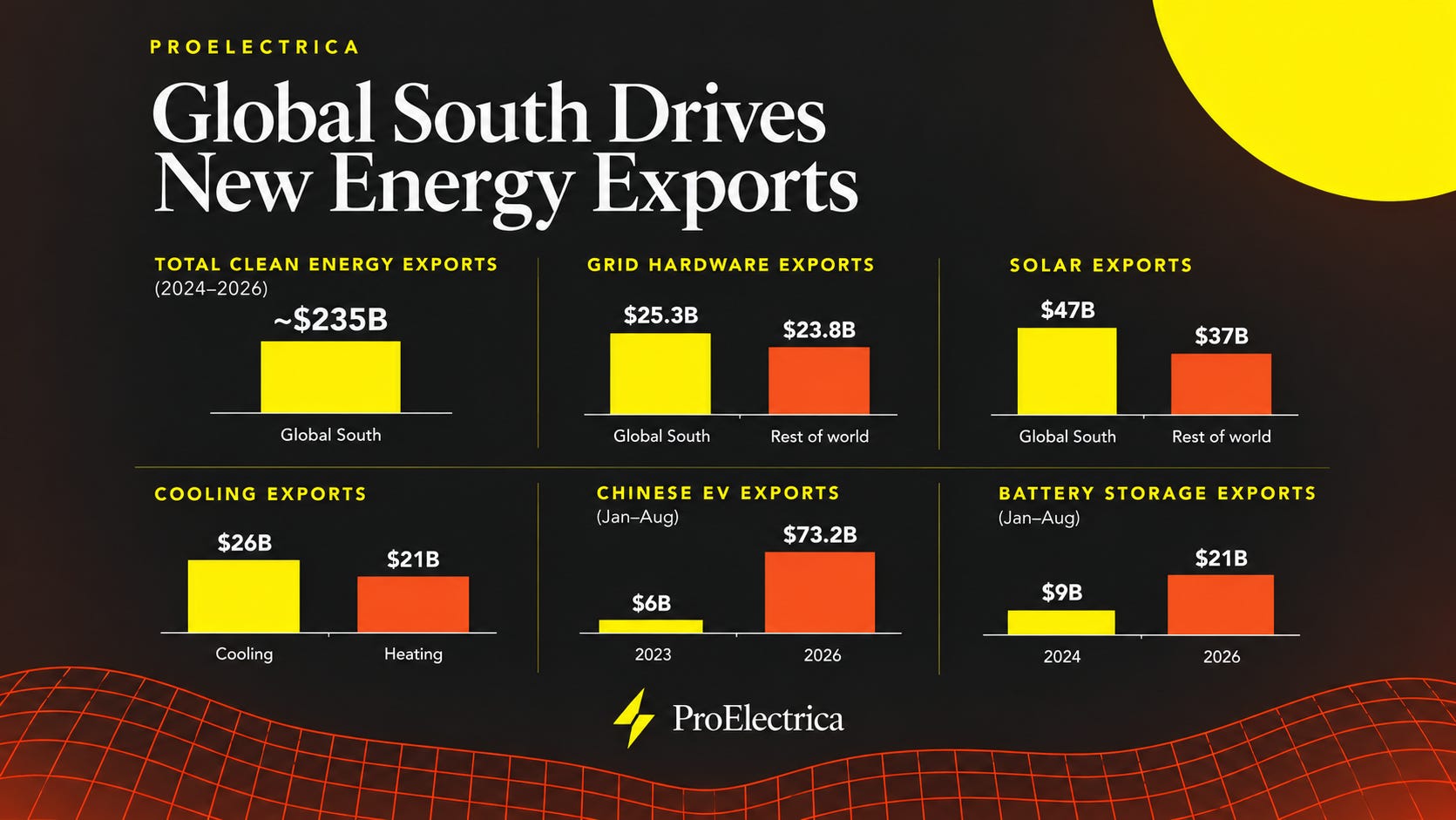
~$235 billion spent by the Global South on imported Chinese clean-energy tech in under three years. Barely a headline, given the war with Iran.
Grids, not just panels. India, Pakistan, the Philippines, Vietnam, Brazil and South Africa (among others) spent $25.3 billion on transformers, switchgear and cable, against $23.8 billion for the rest of the world combined. Emerging markets have led grid-hardware spend for most of the past three years. This is system-building, not box-ticking.
Solar: ~$47 billion vs $37 billion. That’s 55.4% of all spending on Chinese solar going to the Global South.
Cooling: ~$26 billion vs $21 billion on heating and cooling kit. In hot, fast-growing cities, air conditioning is the load to watch, utilities are wiring up ahead of it.
EVs: $73.2 billion on Chinese EVs in the first eight months of 2026, up from $6B in the same months of 2023 (rich countries still spend more - $116.5B).
The big gap is batteries. Developed economies took 71% of Chinese storage spend since 2024. But Global South storage spend more than doubled, from ~$9 billion (Jan–Aug 2024) to $21 billion (Jan–Aug 2026).
Deflation bonus: it’s worth noting that these are dollar figures, and Chinese prices keep falling. Each dollar buys more kit than last year, so the physical build-out is bigger than the spend suggests.
The expensive alternative. Now for the fossil side of the ledger (Kpler, LSEG and HiLo Analytics data, also via Reuters):
Middle East crude exports are back to 15.4 million bpd, nearly 90% of pre-war. Hormuz flows are around three-quarters of pre-war.
But shipping a 2-million-barrel cargo from Nigeria to Singapore now costs ~$32 a barrel, roughly 8x pre-war.
Freight and insurance used to be 3–7% of a delivered barrel. For some refiners it is now up to 30%.
Asian refiners make ~40 a barrel gross, pay ~33 in freight, and keep about $7. Freight eats 82% of their margin, against ~16% in the US Gulf Coast and Northwest Europe.
Gulf sellers are reportedly discounting up to $30 a barrel just to stay competitive.
That’s the polycrisis and the the polyopportunity in a single ledger. Every imported barrel is hostage to a strait, a shuttle fleet of tankers and an insurance premium, and Asia pays the most for it. Every panel, transformer and cable is bought once and then runs on sunshine. As the Reuters column put it: the Strait of Hormuz may or may not fully reopen; the transformers aren’t going anywhere.
Nobody in Manila, Karachi or Hanoi wrote a grand industry strategy nor just energy transition plan for this. Thousands of utilities, importers and households made ad hoc, case-by-case calls to survive the crisis in front of them. Added up, they look a lot like a plan though. That’s Asia as method.
The missing pieces are clear: storage, and the finance to buy it at the pace the panels are arriving. Close that gap and the world may be OK. But then there is a Super El Nino coming, which will impact Asia more than anywhere else. Can we really speak of opportunity in such a state? Your thoughts?
Shine on ☀️
Sources: Reuters, “Global South is wiring up an electric future” (Oct 19, 2026), citing Ember; Reuters ROI column on Asian refiners’ freight squeeze, citing Kpler, LSEG and HiLo Analytics.